Asisebenze’s Position: Why We Choose to Work Where We Are
Published 21 October 2026 in Blog
By Nomonde Kananda
Where an art space chooses to exist is never simply a question of location. It is also about who it hopes to reach, the communities it wants to engage with, and the relationships it hopes to build. A gallery occupies a physical address, but it also holds a position within a wider cultural, social, and economic landscape. At Asisebenze Art Gallery, where we choose to work is part of how we understand our role in the art world—and the responsibilities that come with it.
Johannesburg is a city shaped by movement, contradiction, creativity, and constant transformation.


Its cultural landscape reflects a complex history, while its contemporary art scene continues to be shaped by the people who live, work, create, and gather here. In this environment, the location of an art space carries meaning. It influences who encounters the work, who feels welcome to enter, and what conversations can emerge when people share a space.
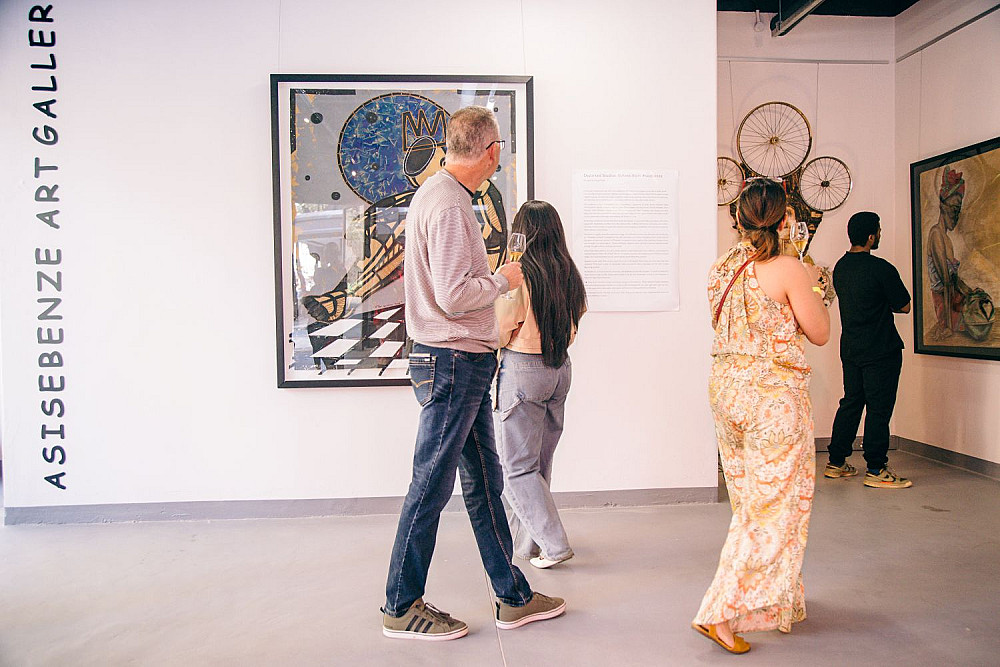
Our presence in Marshalltown places us within the everyday rhythms of the city. Here, art exists alongside commerce, work, public movement, and the realities of urban life. We are interested in what it means for contemporary art to inhabit this context rather than exist separately from it. Art does not have to be removed from the world to be meaningful. It can meet people where they are, invite them to look differently at their surroundings, and create opportunities for exchange in unexpected places.


Accessibility is central to this thinking. Making art accessible is not only about the physical act of entering a gallery. It also means recognising the social and cultural barriers that can make art spaces feel unfamiliar, exclusive, or reserved for a particular audience. The language used to discuss art, the way exhibitions are presented, and the opportunities audiences have to engage with artists all shape how people experience a space.
We believe a gallery can be a place of encounter, where curiosity is welcomed and engagement does not depend on prior knowledge. Through exhibitions, artist talks, walkabouts, and opportunities for conversation, we seek to create ways for people to connect with the work and the ideas behind it.
These encounters allow art to become more than something viewed from a distance. They create room for questions, interpretation, disagreement, and discovery.


Community engagement is not simply about bringing people through the door. It is about recognising that an art space exists in relationship with the people and environments around it. Artists bring their experiences, histories, and ways of seeing. Audiences bring their own references and interpretations.
The surrounding neighbourhood contributes its own character, challenges, and possibilities. These relationships are not incidental to a gallery’s work; they are part of what gives the space meaning.
Our position is also informed by the understanding that the art ecosystem extends beyond galleries and artists. It includes independent practitioners, curators, cultural workers, collectors, institutions, audiences, and the many people whose labour sustains creative practice. Each operates within particular conditions, with different resources and limitations. Where an organisation chooses to work, how it uses its resources, and which relationships it prioritises all shape how it participates in this ecosystem.
Being intentional about our position requires us to remain conscious of these realities. It means considering how we support artists, communicate with audiences, and contribute to an environment in which creative work can be encountered and valued. It also means recognising that no space operates outside economic pressures, questions of access, or the broader inequalities that shape the cultural sector. Intention alone cannot resolve these challenges, but they remain important considerations in how an organisation understands its responsibilities.
Transparency matters because the decisions behind a cultural space are rarely neutral. Choices about location, programming, partnerships, and public engagement communicate what an organisation values. Art spaces have an opportunity to reflect on these choices openly, acknowledging both their possibilities and their limitations. For us, this is part of developing a practice that responds to its context rather than becoming disconnected from it.
Choosing where we work is therefore not simply about occupying a building or establishing a presence in the city. It is about considering what that presence makes possible, whom it serves, and how it can contribute to a wider culture of artistic exchange. A gallery’s work extends beyond the walls that house its exhibitions and into the relationships formed around them.


At Asisebenze, our position is an ongoing conversation between intention and practice. We continue to consider what accessibility looks like in real terms, how community relationships can be strengthened, and how our presence can contribute meaningfully to the environment in which we operate. These questions cannot be answered once and then set aside. They require attention, reflection, and a willingness to keep learning.
Ultimately, where we choose to work is inseparable from why we work. We see the gallery as part of a living cultural landscape, shaped by the people who move through it and the conversations that take place within and beyond its walls. Our commitment is to remain attentive to that landscape, to the artists whose work we present, and to the audiences with whom we share it.
An art space is not defined by its address alone. Over time, it is defined by the relationships it builds, the values it puts into practice, and the possibilities it creates for art to meet the world.