Is South African Art Still Explaining Itself?
Published 23 January 2026 in Blog
By Nomonde Kananda
Contemporary South African art is often rich with symbolism, layered references, and emotional depth. Yet one recurring question continues to surface in exhibition spaces and conversations around the work: How much explanation is needed for art to be understood?
This question becomes particularly relevant when encountering work that resists literal interpretation. Many contemporary artists intentionally leave space for ambiguity, inviting viewers to engage intuitively, emotionally, and critically rather than searching for a single fixed meaning. In these moments, the relationship between the artwork and the audience becomes an active exchange rather than a one-directional statement.


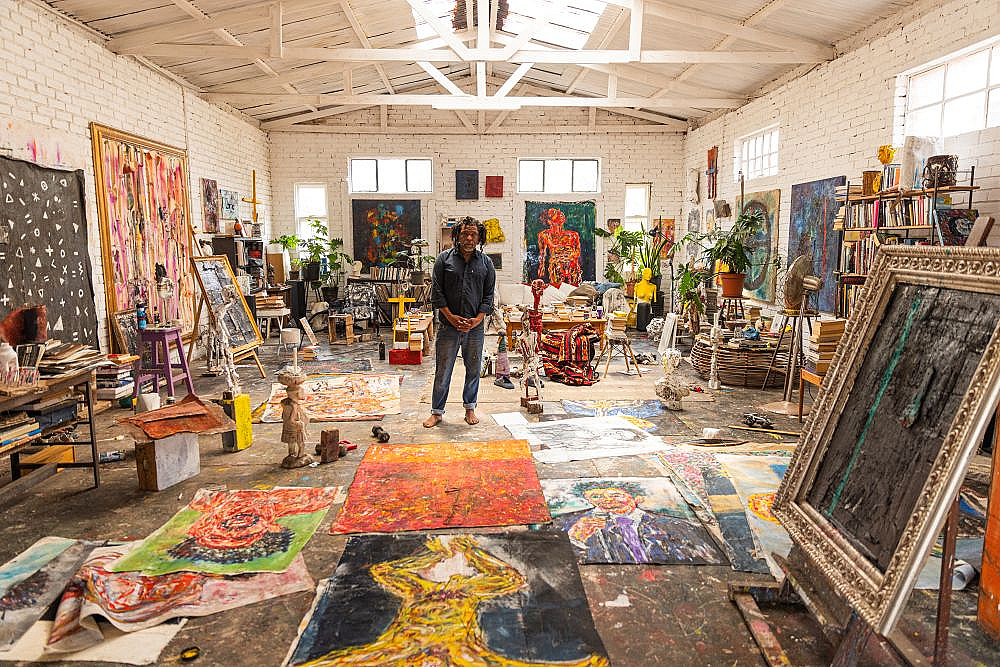
Thokozani Mthiyane’s current exhibition offers a useful lens through which to consider this dynamic. His practice includes figurative finger paintings, abstract compositions, and sculptural elements that incorporate symbolic materials such as nails and crosses. While the works are visually striking, their meaning is not immediately prescribed. Instead, viewers are invited to spend time with the work, noticing form, texture, repetition, and symbol, and allowing personal associations to emerge.
Historically, South African art has often been approached through explanatory frameworks, shaped by political history, social struggle, and institutional expectations. While context remains important, an over-reliance on explanation can sometimes limit how work is experienced, reducing it to illustration rather than allowing it to function as an open-ended visual language.
This does not suggest that artists should withhold context entirely, nor that audiences should disengage from historical and social realities. Rather, it raises the possibility that meaning can exist on multiple levels at once. An artwork may carry personal, cultural, and historical significance while still leaving room for individual interpretation and emotional response.
In this way, contemporary art asks something of its viewers: time, attentiveness, and a willingness to sit with uncertainty. Instead of immediately seeking answers, viewers are encouraged to ask their own questions. What draws me to this image? What emotions does it evoke? What associations do the materials carry for me?

At Asisebenze Art Atelier, this approach aligns with how we understand exhibitions, not as spaces where meaning is delivered, but where dialogue begins. Exhibitions become sites of encounter, reflection, and conversation, where artists and audiences meet without the pressure of resolution.
As South African art continues to evolve, perhaps the question is no longer whether art is still explaining itself, but whether we are allowing ourselves the space to listen, observe, and engage beyond explanation.