Resistance, Survival, and Making
Published 18 February 2026 in Blog
By Nomonde Kananda
Art does more than decorate walls or fill gallery spaces. It serves as a mirror of human experience, a visual record that helps us understand who we were, how people lived, and what mattered most in different eras. The earliest examples of human creativity, prehistoric cave paintings, show this clearly: even without written language, humans used art to make sense of their world, depict the animals and environments around them, and express shared meaning. These ancient works are among the first windows we have into human life tens of thousands of years ago.


In The Story of Art, one of the most celebrated introductions to art history, author E.H. Gombrich begins exactly at these cave paintings, tracing art across time and emphasizing that artistic expression always reflects the context in which it is made, from early human marks on stone to the masterpieces of later periods.
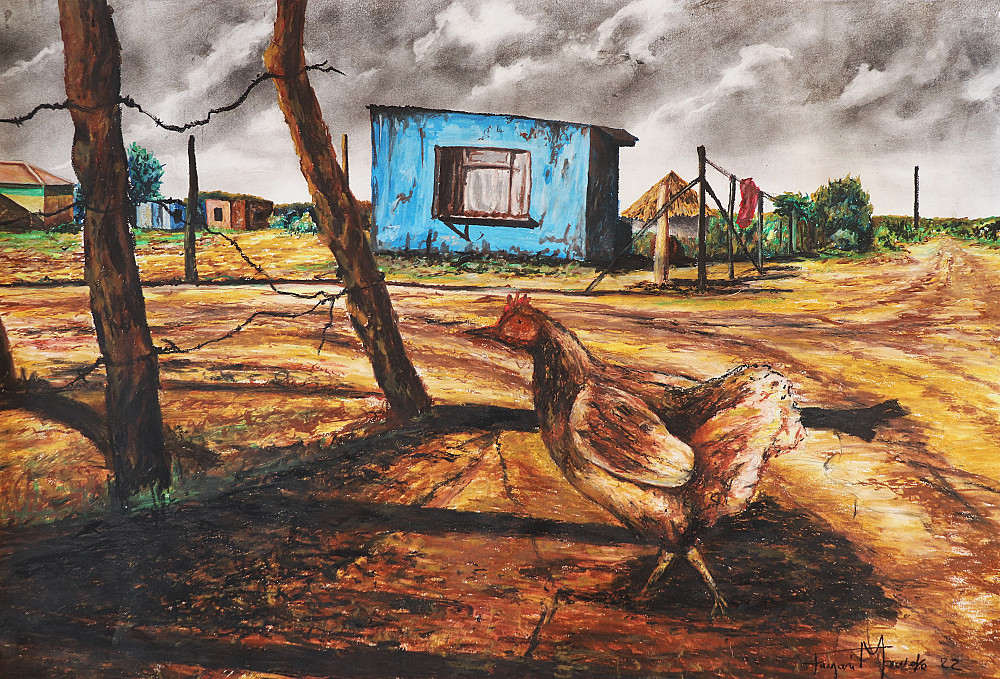
This simple but profound idea, that art reflects its time, remains at the heart of understanding South African artistic practice as well. Artists create within conditions shaped by the realities around them: community life, cultural exchange, economic constraints, and evolving social priorities. The pressures and possibilities of any era influence what artists choose to depict, the materials they use, and the places where they share their work.

The act of making art can be seen as a form of resilience. In environments where resources may be limited or opportunities unevenly distributed, artists find ways to express ideas anyway, using alternative materials, collaborating with peers, or exploring new spaces for creation. This resourcefulness becomes part of the creative process itself, shaping distinct styles and methods.
Art also functions as a record of how people understand their world. Just as we look at cave paintings and see landscapes, animals, and symbolic marks that speak to early humans’ relationship with their environment, contemporary art can reveal how artists perceive the issues of their own time. Whether addressing identity, community, memory, or everyday life, creative works offer insight that goes beyond surface appearance, connecting us to shared experience and collective reflection.

Importantly, art history is not simply about comparing styles or celebrating famous names. It’s a conversation across time, a way of seeing how people have responded to the conditions of their lives, how they’ve navigated pressure and uncertainty, and how they’ve made meaning through creative expression. Artists are influenced by what surrounds them, and in turn, their work influences how future generations understand those times.
In South Africa, this dynamic relationship between art and context is rich and varied. Across decades and generations, artists have engaged with personal and collective experience, capturing the rhythms of life in ways that resonate both locally and globally. Many contemporary practices remain grounded in questions of identity, community, belonging, and connectedness, demonstrating that art continues to reflect the times just as powerfully today as it did in the deepest past.
To view art only as an aesthetic object is to miss part of its impact. When we look at creative work as a response to lived experience, we see that every artwork embodies a kind of dialogue, with its maker, with its audience, and with the moment in which it was created. Art is a space where survival and making meet; where expression becomes a form of continuity across time; and where resistance itself can be quiet, thoughtful, and deeply human.

By appreciating this, we not only honor the creative gestures of people long ago, like those who painted in the flickering cave light, but we also honor the work of artists today, whose practices reflect our present moments and help us imagine what comes next.